
SnapStepsCalc

    Average Step Length by Height (cm, m & ft)

    Average step length is about 41.5% of your height for men and 41.3% for women. A 170 cm person has a step length of approximately 70 cm (0.70 m / 2.30 ft). Use the table below for your exact value.

    A

    Quick answer

    Quick rule: step length ≈ height × 0.414. For a 170 cm (5'7") person that's ~70 cm (0.70 m or 2.30 ft) per step, meaning roughly 1,429 steps per kilometer or 2,300 steps per mile at a normal walking pace.

    Numbers use average adult stride and MET-based energy expenditure. See our methodology for the exact formulas and sources.

    SnapStepsCalc TeamPublished June 10, 20266 min read
    Person walking on a coastal path showing natural stride length
    Step length scales linearly with height — taller walkers cover more ground per step.

    Choose calculation type

    Enter your step count to see distance, calories & time

    steps

    Enter the number from your fitness tracker, phone, or pedometer

    Add your height, weight, terrain & fitness level for personalized results

    FemaleMale
    lbs

    Used for accurate calorie calculations

    inches

    Enter your height in inches (5'8" = 68 inches)

    ft

    Default: 2.43 ft — enter your height for a personalized stride

    0% (Flat)5% (Moderate)10% (Steep)15%
    US (mi, lbs, ft)Metric (km, kg, m)

    Auto-detected based on your location. Change if needed.

    100% private — all calculations happen in your browser

    👇 Keep reading for detailed breakdown, data tables & real-life examples

    How Step Length Is Calculated From Height

    The most widely used formula comes from biomechanics research: step length = height × 0.415 (men) or × 0.413 (women). For everyday use, the unisex average of 0.414 is accurate to within ±3 cm for most adults.

    A 170 cm tall person therefore has an average step length of 170 × 0.414 = 70.4 cm, or 0.70 m / 2.31 ft. This is the distance between the heel of one foot and the heel of the opposite foot during normal walking — not a full stride (which is two steps).

    Step length varies ±5–10% based on pace, fitness, terrain, and footwear. Brisk walking can add 5–8 cm per step, while uneven ground or carrying weight can reduce it by a similar amount.

    Why Height Predicts Step Length So Well

    Step length is fundamentally a function of leg length, which scales linearly with height across adult populations. Leg length is roughly 48–50% of total height, and the natural pendulum-like swing of the leg during walking produces a step that is about 83% of leg length — giving the well-established 0.41–0.42 ratio of step length to total height.

    Men vs Women: Small but Real Differences

    Men average a step length of 41.5% of height, women 41.3%. This 0.2 percentage-point gap reflects subtle differences in pelvis geometry and hip rotation rather than leg length alone. For practical purposes — calorie estimation, distance tracking, treadmill calibration — the unisex 0.414 ratio is accurate enough.

    Step Length vs Stride Length

    Step length is heel-to-heel between opposite feet (one footfall). Stride length is heel-to-heel of the SAME foot (two footfalls). So stride length = 2 × step length. A 170 cm person has ~70 cm step length and ~140 cm stride length. Most fitness trackers and pedometers report step length, not stride.

    How Pace Changes Your Step Length

    At a leisurely 3 km/h, step length is typically 5–10% shorter than your height-based estimate. At brisk 5.5 km/h it matches the formula closely. At power-walking pace (6.5+ km/h) it can be 5–8% longer. Running stretches step length by 30–80% depending on speed.
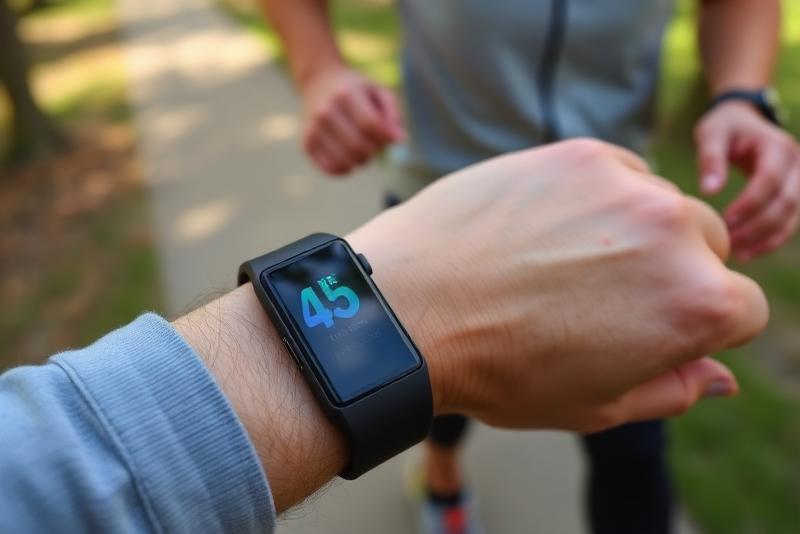
    Fitness tracker on a wrist measuring step length and cadence
    Modern fitness trackers estimate stride length using your height and cadence.

    Step Length by Height – Full Reference Table

    Height (cm)Height (ft / in)Step length (cm)Step length (m)Step length (ft)Steps per kmSteps per mile
    1504'11"620.622.041,6132,597
    1555'1"640.642.101,5632,516
    1605'3"660.662.171,5152,439
    1655'5"680.682.241,4712,367
    1705'7"700.702.301,4292,299
    1755'9"720.722.371,3892,235
    1805'11"750.752.441,3332,146
    1856'1"770.772.511,2992,090
    1906'3"790.792.581,2662,037
    1956'5"810.812.651,2351,987
    2006'7"830.832.721,2051,940

    Unisex average: step length = height × 0.414. Steps per km/mile assume normal walking pace. Individual stride may vary ±5–10%.

    How we calculate this (worked example)

    Every figure on this page is produced by the same calculation engine as the calculator above — no hardcoded numbers. Here is the full arithmetic for 10,000 steps at 70 kg (154 lbs), moderate pace, flat ground.

    1. Distance: 10,000 steps × 0.74 m ÷ 1,000 = 7.40 km (4.60 miles)
    2. Walking time: 7.40 km ÷ 5 km/h × 60 = 1h 29m (89 minutes)
    3. Calories: 3.5 MET × 70 kg × 3.5 ÷ 200 × 89 min = 381 kcal
    4. Per step: 381 kcal ÷ 10,000 steps = 0.038 kcal per step

    10,000 steps by body weight

    Distance, walking time and calories burned for 10,000 steps at four body weights, moderate pace on flat ground
    Body weightDistanceWalking timeCalories burned
    55 kg (121 lbs)7.40 km (4.60 mi)1h 29m299 kcal
    70 kg (154 lbs)7.40 km (4.60 mi)1h 29m381 kcal
    85 kg (187 lbs)7.40 km (4.60 mi)1h 29m462 kcal
    100 kg (220 lbs)7.40 km (4.60 mi)1h 29m544 kcal

    Distance and time are identical across weights (7.4 km at 0.74 m stride) because only energy expenditure scales with body mass.

    Definitions

    Step
    One single footfall. Two steps make one full stride cycle, so a pedometer counting 10,000 steps records 5,000 complete left-right cycles.
    Stride length
    The horizontal distance covered by one step, measured heel-to-heel. We use 0.74 m (2.43 ft) as the average adult value, or 0.415 × height in cm for men and 0.413 × height for women.
    Walking distance
    Steps × stride length. Distance in kilometres = (steps × stride in metres) ÷ 1,000; miles = kilometres × 0.621371.
    Calories burned
    Energy expenditure estimated with the MET equation: kcal = MET × weight (kg) × 3.5 ÷ 200 × minutes. Moderate walking at 5 km/h is MET 3.5.
    Walking time
    Distance ÷ walking speed. At the 5 km/h baseline, one kilometre takes 12 minutes and one mile takes about 19 minutes.
    Cadence
    Steps per minute. A moderate 5 km/h pace corresponds to roughly 100–110 steps per minute; brisk walking is 120+ steps per minute.

    Assumptions and rounding rules

    Default parameters and rounding rules used in every calculation
    ParameterDefaultRule
    Stride length0.74 m (2.43 ft)Average adult; overridden by your height or entered stride
    Walking pace5 km/h (3.1 mph)Moderate, flat ground; reduced 20% on hills and 30% on trails
    MET value3.50Flat terrain, moderate fitness; +0.1 MET per 1% incline
    Body weight70 kg (154 lbs)Reference weight for examples; your input replaces it
    Distance rounding2 decimals (km and miles)Rounded for display only — full precision is used in the maths
    Calorie roundingNearest whole kcalRounded at the last step, never mid-calculation
    Step roundingNearest whole stepReverse calculations round to the nearest integer step

    Limitations

    • All results are estimates, not measurements. MET-based calorie models typically fall within ±10–20% of indirect calorimetry for an individual.
    • Individual differences in gait efficiency, age, body composition and fitness change actual energy cost at the same speed.
    • Terrain, surface softness, wind and altitude are only partly captured by the terrain and incline settings.
    • Stride length varies with pace, footwear and fatigue; a single average stride cannot represent a whole walk.
    • Pedometers and phone accelerometers miscount steps by roughly 5–15%, especially at slow speeds or when carried in a bag.
    • Figures describe activity energy expenditure only and exclude resting metabolism, so they should not be subtracted twice from a daily budget.

    Method: stride-based distance plus the MET equation from the Compendium of Physical Activities (Ainsworth et al.). Results are estimates — see our estimation disclaimer.

    Key takeaway

    Your average step length equals roughly 41.4% of your height. A 170 cm person walks at ~70 cm per step (1,429 steps/km), a 180 cm person at ~75 cm (1,333 steps/km), and a 160 cm person at ~66 cm (1,515 steps/km). Use the table above for your exact value, and calibrate your fitness tracker accordingly for accurate distance and calorie data.

    Want your exact number?

    Real-Life Scenarios

    Calibrating a Fitness Tracker (170 cm)

    Maria, 170 cm tall, sets her step length on Garmin Connect to 70 cm. Her 5 km morning loop now correctly registers as 7,143 steps instead of the default 7,500. Over a year of daily walking, this 5% correction matters: it prevents her from over-reporting distance and calorie burn by roughly 18,250 steps.

    Tall Walker Optimization (190 cm)

    Tom, 190 cm, naturally has a 79 cm step length. To reach 10,000 daily steps, he covers 7.9 km — almost a full kilometer more than a 170 cm walker doing the same step count. He uses this knowledge to set his daily target at 9,000 steps (still 7.1 km) and saves about 8 minutes of walking time per day.

    Pace-Adjusted Estimate (165 cm)

    Sarah, 165 cm, has a base step length of 68 cm. During her brisk lunchtime walks at 6 km/h she measures her actual stride at 72 cm — 6% longer than the formula predicts. She updates her tracker to 72 cm for accurate brisk-walk distance, but keeps 68 cm for casual all-day step counting.

    Walker on a forest trail demonstrating natural walking stride
    Stride length naturally increases on flat, open terrain and decreases on uneven ground.

    In summary: Your average step length equals roughly 41.4% of your height. A 170 cm person walks at ~70 cm per step (1,429 steps/km), a 180 cm person at ~75 cm (1,333 steps/km), and a 160 cm person at ~66 cm (1,515 steps/km). Use the table above for your exact value, and calibrate your fitness tracker accordingly for accurate distance and calorie data.

    Frequently Asked Questions

    What is the average step length for a 170 cm person in meters?

    Approximately 0.70 m (70 cm or 2.30 ft) using the standard formula: height × 0.414.

    How many steps are in 1 km for someone 170 cm tall?

    About 1,429 steps per kilometer at a normal walking pace, based on a 70 cm step length.

    Is step length the same as stride length?

    No. Step length is the distance between opposite feet (one footfall). Stride length covers two steps — heel to heel of the same foot. Stride length = 2 × step length.

    Does step length differ between men and women?

    Slightly. Men average 41.5% of height; women average 41.3%. The difference is about 1 cm for an average-height adult — negligible for most tracking purposes.

    How accurate is the height-based step length formula?

    Within ±5–10% for most adults walking at normal pace. Factors like fitness, age, terrain, and footwear can shift it. For best accuracy, measure your actual step length over 10 steps and use that value.

    Popular Conversion References