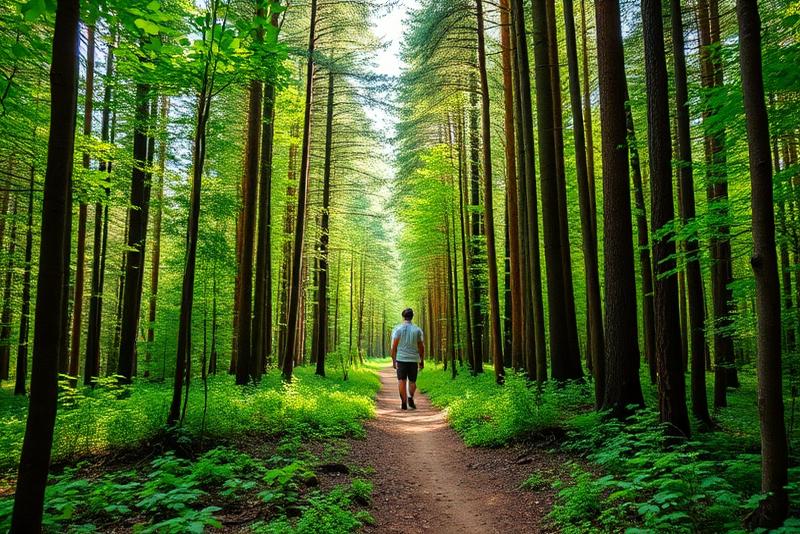
The Math Behind 7,000 Steps
7,000 steps × 0.74 m average stride = 5,180 m, or 5.18 km (3.22 miles).
At a moderate 5 km/h that's about 62 minutes on your feet — enough to raise your heart rate meaningfully if any portion is brisk.
Energy expenditure scales with body weight. A 55 kg walker burns ~209 kcal here, a 95 kg walker ~362 kcal.
Who benefits most from 7,000 steps?
Most healthy adults 40+ looking for a maintainable, evidence-based target that fits into a real workday.
What 7,000 steps won't do
7,000 steps alone won't build strength or produce big weight loss — pair with 2 resistance sessions per week and a nutrition plan for body-composition change.
Making 7,000 steps count more
Add a 3–5% incline or 10 minutes of brisk pace inside the block — a 70 kg walker jumps from 267 to ~381 kcal without extra time. Split the walk across 3 sessions (morning, lunch, evening) to compound heart-rate benefits.
How it compares to the guidelines
The WHO 150 min/week moderate-activity target maps to roughly 7,000–8,000 steps/day when a portion is brisk. Compare your target above and below to see where you land.
Calories Burned in 7,000 Steps by Body Weight
| Weight | Moderate Pace | Brisk Pace | Approx. Time |
|---|---|---|---|
| 55 kg (121 lbs) | 209 kcal | 230 kcal | 62 min |
| 65 kg (143 lbs) | 247 kcal | 272 kcal | 62 min |
| 75 kg (165 lbs) | 286 kcal | 314 kcal | 62 min |
| 85 kg (187 lbs) | 324 kcal | 356 kcal | 62 min |
| 95 kg (209 lbs) | 362 kcal | 397 kcal | 62 min |
| 110 kg (242 lbs) | 419 kcal | 460 kcal | 62 min |
MET-based estimates (3.5 moderate / 5.0 brisk). Personal results vary with terrain, incline, and fitness level.
How we calculate this (worked example)
Every figure on this page is produced by the same calculation engine as the calculator above — no hardcoded numbers. Here is the full arithmetic for 10,000 steps at 70 kg (154 lbs), moderate pace, flat ground.
- Distance: 10,000 steps × 0.74 m ÷ 1,000 = 7.40 km (4.60 miles)
- Walking time: 7.40 km ÷ 5 km/h × 60 = 1h 29m (89 minutes)
- Calories: 3.5 MET × 70 kg × 3.5 ÷ 200 × 89 min = 381 kcal
- Per step: 381 kcal ÷ 10,000 steps = 0.038 kcal per step
10,000 steps by body weight
| Body weight | Distance | Walking time | Calories burned |
|---|---|---|---|
| 55 kg (121 lbs) | 7.40 km (4.60 mi) | 1h 29m | 299 kcal |
| 70 kg (154 lbs) | 7.40 km (4.60 mi) | 1h 29m | 381 kcal |
| 85 kg (187 lbs) | 7.40 km (4.60 mi) | 1h 29m | 462 kcal |
| 100 kg (220 lbs) | 7.40 km (4.60 mi) | 1h 29m | 544 kcal |
Distance and time are identical across weights (7.4 km at 0.74 m stride) because only energy expenditure scales with body mass.
Definitions
- Step
- One single footfall. Two steps make one full stride cycle, so a pedometer counting 10,000 steps records 5,000 complete left-right cycles.
- Stride length
- The horizontal distance covered by one step, measured heel-to-heel. We use 0.74 m (2.43 ft) as the average adult value, or 0.415 × height in cm for men and 0.413 × height for women.
- Walking distance
- Steps × stride length. Distance in kilometres = (steps × stride in metres) ÷ 1,000; miles = kilometres × 0.621371.
- Calories burned
- Energy expenditure estimated with the MET equation: kcal = MET × weight (kg) × 3.5 ÷ 200 × minutes. Moderate walking at 5 km/h is MET 3.5.
- Walking time
- Distance ÷ walking speed. At the 5 km/h baseline, one kilometre takes 12 minutes and one mile takes about 19 minutes.
- Cadence
- Steps per minute. A moderate 5 km/h pace corresponds to roughly 100–110 steps per minute; brisk walking is 120+ steps per minute.
Assumptions and rounding rules
| Parameter | Default | Rule |
|---|---|---|
| Stride length | 0.74 m (2.43 ft) | Average adult; overridden by your height or entered stride |
| Walking pace | 5 km/h (3.1 mph) | Moderate, flat ground; reduced 20% on hills and 30% on trails |
| MET value | 3.50 | Flat terrain, moderate fitness; +0.1 MET per 1% incline |
| Body weight | 70 kg (154 lbs) | Reference weight for examples; your input replaces it |
| Distance rounding | 2 decimals (km and miles) | Rounded for display only — full precision is used in the maths |
| Calorie rounding | Nearest whole kcal | Rounded at the last step, never mid-calculation |
| Step rounding | Nearest whole step | Reverse calculations round to the nearest integer step |
Limitations
- All results are estimates, not measurements. MET-based calorie models typically fall within ±10–20% of indirect calorimetry for an individual.
- Individual differences in gait efficiency, age, body composition and fitness change actual energy cost at the same speed.
- Terrain, surface softness, wind and altitude are only partly captured by the terrain and incline settings.
- Stride length varies with pace, footwear and fatigue; a single average stride cannot represent a whole walk.
- Pedometers and phone accelerometers miscount steps by roughly 5–15%, especially at slow speeds or when carried in a bag.
- Figures describe activity energy expenditure only and exclude resting metabolism, so they should not be subtracted twice from a daily budget.
Method: stride-based distance plus the MET equation from the Compendium of Physical Activities (Ainsworth et al.). Results are estimates — see our estimation disclaimer.
Calorie burn scales with body weight
Bar length shows relative energy expenditure. A heavier body must move more mass per step, so the same step count burns proportionally more calories.
Key takeaway
7,000 steps ≈ 5.18 km, ~267 kcal (70 kg), ~62 min. Backed by the strongest available research as a daily target for most adults.
Want your exact number?
Real-Life Scenarios
The office worker
Two 15-minute walks + one lunch loop typically clears 7,000 steps. Print a 5-day tracker and tick each session — consistency beats a single 'catch-up' Sunday.
The parent on school runs
Two school-run loops (morning + afternoon) plus household movement often lands right at 7,000 steps. Add a 10-minute post-dinner walk on non-active days.
The recovering runner
On rest days, 7,000 easy steps maintain circulation without loading joints. Keep pace under 5 km/h and avoid hills to stay in the recovery zone.

In summary: 7,000 steps ≈ 5.18 km, ~267 kcal (70 kg), ~62 min. Backed by the strongest available research as a daily target for most adults.