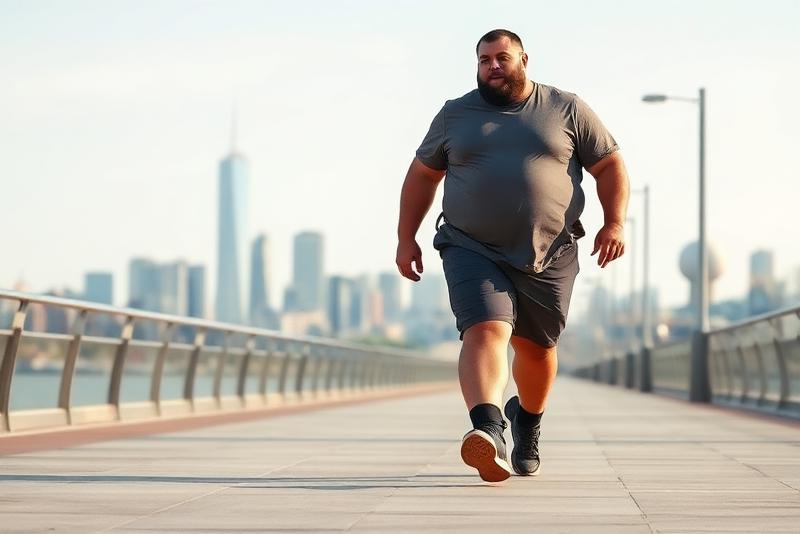
The 500-Calorie Formula at 100 kg
At 100 kg, the MET formula delivers impressive per-step numbers: Calories/min = (3.5 × 100 × 3.5) / 200 = 6.125 kcal/min during brisk walking.
With a cadence of 100 steps/min, gross burn is ~0.0613 kcal/step. Subtracting resting metabolism (~1.46 kcal/min at 100 kg), the net burn is approximately 0.0438 kcal per step — 67% more than someone at 60 kg.
500 ÷ 0.058 ≈ 8,600 steps. At a 0.78 m stride, that's 8.9 km and about 114 minutes of walking. This is remarkably achievable — many people already walk 8,000–10,000 steps daily, so you're only 1,430–3,430 steps away from a 500-calorie burn.
Why 100 kg Makes Walking Incredibly Efficient
At 100 kg, your body expends 43.8 calories per 1,000 steps — the highest burn rate in the common weight range. A person at 60 kg would need to walk 67% further to burn the same calories. This means walking is one of the most effective exercises for individuals at this weight, delivering maximum results for minimum time investment.
Building Endurance Progressively
If 11,430 steps feels daunting initially, start with 6,000–7,000 steps daily (about 300–350 calories) and add 500 steps per week. Within 10 weeks, you'll comfortably reach the 500-calorie target. This progressive approach lets your cardiovascular system, muscles, and joints adapt safely — and you'll likely lose weight during the build-up phase too.
Footwear and Surface Considerations
At 100 kg, your feet absorb forces of 200–300 kg per step. Invest in stability-category walking shoes with firm heel counters and ample midsole cushioning. Replace shoes every 500–700 km (roughly every 3–4 months if walking daily). Prefer asphalt or rubberized tracks over concrete, and avoid uneven cobblestones that increase ankle strain.
The Power of Walking for Weight Loss at 100 kg
Walking 8,600 steps daily creates a 500-calorie deficit, leading to approximately 0.45 kg (1 lb) of weight loss per week — without changing your diet. As your weight decreases, you'll need slightly more steps for the same burn, but your fitness will improve simultaneously, making the additional steps feel easier.

500 Calories at 100 kg — Pace Comparison
| Walking Pace | MET | Steps Needed | Distance (km) | Time (min) |
|---|---|---|---|---|
| Slow (3.5 km/h) | 2.8 | ~10,700 | ~8.0 | ~102 |
| Moderate (4.5 km/h) | 3.0 | ~13,330 | ~10.4 | ~133 |
| Brisk (5.5 km/h) | 3.5 | ~8,600 | ~6.5 | ~82 |
| Power walk (6.5 km/h) | 4.3 | ~9,300 | ~7.3 | ~93 |
| Brisk + 5% incline | 5.0 | ~8,000 | ~6.2 | ~80 |
| Trail / hilly | 6.0 | ~6,670 | ~5.2 | ~67 |
Calculations for 100 kg body weight, stride length 0.78 m.
Key takeaway
At 100 kg, burning 500 calories requires only about 11,430 steps — roughly 8.9 km of brisk walking. Your body weight makes walking exceptionally efficient for calorie burning. Build up gradually, invest in proper footwear, and consider splitting walks into two sessions for optimal results.
Want your exact number?
Real-Life Scenarios
The Step-by-Step Beginner
David, 100 kg, starts at 6,000 steps/day (263 cal). Each week he adds 500 steps. By week 11, he's at 11,500 steps daily (500 cal). During the build-up, he's already lost about 3 kg from the progressive calorie deficit. His knees adapted gradually, and he now walks comfortably for 2 hours.
The Two-Session Day
David splits his target: a 35-minute morning walk (4,500 steps, ~197 cal) and a 50-minute evening walk (6,930 steps, ~303 cal). The morning session energizes him for work, and the evening walk helps him unwind. Total: 8,600 steps, 500 calories, zero gym membership needed.
The Rainy Day Plan
On wet days, David walks at the local indoor mall for 45 minutes (5,850 steps) and does 45 minutes on a treadmill at 5 km/h with 3% incline (5,580 steps at MET ~4.0). Total: 8,600 steps, 500 calories, completely weather-proof.
In summary: At 100 kg, burning 500 calories requires only about 11,430 steps — roughly 8.9 km of brisk walking. Your body weight makes walking exceptionally efficient for calorie burning. Build up gradually, invest in proper footwear, and consider splitting walks into two sessions for optimal results.