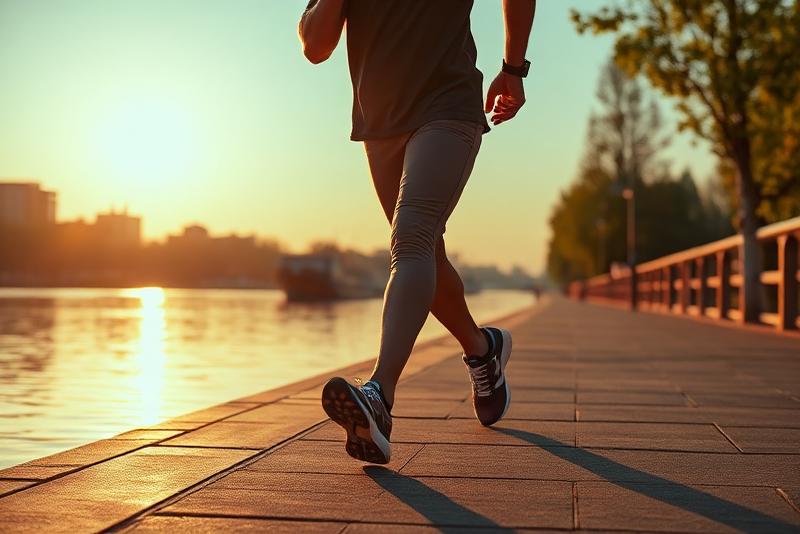
The Math Behind 500 Calories at 80 kg
Using the standard MET formula: Calories/min = (MET × body weight in kg × 3.5) / 200. At 80 kg with MET 3.5: (3.5 × 80 × 3.5) / 200 = 4.9 kcal/min.
At a brisk walking cadence of about 100 steps per minute, each step burns approximately 0.049 kcal gross. Subtracting resting metabolic expenditure (~1.17 kcal/min at 80 kg), the net burn is about 0.035 kcal per step.
500 ÷ 0.047 ≈ ~10,700 steps. That's roughly 11.1 km (assuming a 0.78 m stride) and about 143 minutes of walking. The 80 kg sweet spot means you burn substantially more per step than someone at 60 kg, making the 500-calorie target quite achievable in a single long walk.
The 80 kg Advantage
At 80 kg, you sit in a calorie-burning sweet spot: heavy enough to burn significantly more per step than lighter individuals, yet mobile enough for sustained walking sessions. You burn roughly 35 calories per 1,000 steps, compared to 26 at 60 kg — a 35% increase in efficiency per step.
Speed Optimization at 80 kg
Increasing from 5 km/h (MET 3.5) to 6.5 km/h (MET 4.3) drops the required steps from ~10,700 to ~8,700. At 7 km/h race-walking pace (MET ~5.0), you'd need only ~10,000 steps. For an 80 kg individual, each km/h increase saves about 1,000–1,500 steps.
Incline Walking for 80 kg Walkers
A 5% treadmill incline increases MET to ~5.0, reducing the target to about 10,000 steps. A 10% incline (MET ~6.3) drops it further to ~7,940. However, joint stress increases with both weight and incline — if you weigh 80 kg, consider limiting steep inclines to 20-minute intervals with flat recovery periods.
Joint-Friendly Strategies
At 80 kg, each step exerts about 240 kg of force on your knees during walking. Invest in quality cushioned walking shoes, prefer grass or rubberized tracks over concrete, and consider breaking the 10,700 steps into two 5,350-step sessions if you experience any discomfort.
500-Calorie Burn: Steps by Pace at 80 kg
| Walking Pace | MET | Steps Needed | Distance (km) | Time (min) |
|---|---|---|---|---|
| Slow (3.5 km/h) | 2.8 | ~17,860 | ~13.9 | ~179 |
| Moderate (4.5 km/h) | 3.0 | ~16,670 | ~13.0 | ~167 |
| Brisk (5.5 km/h) | 3.5 | ~10,700 | ~8.0 | ~102 |
| Power walk (6.5 km/h) | 4.3 | ~11,630 | ~9.1 | ~116 |
| Brisk + 5% incline | 5.0 | ~10,000 | ~7.8 | ~100 |
| Trail / hilly | 6.0 | ~9,400 | ~6.5 | ~83 |
Calculations for 80 kg body weight, stride length 0.78 m.
Key takeaway
An 80 kg person burns 500 calories in approximately 14,290 steps — about 11.1 km of brisk walking. The 80 kg body weight provides an excellent calorie-burning efficiency, and strategies like incline walking or power walking pace can reduce the step count to under 10,000.
Want your exact number?
Real-Life Scenarios
The Commute Walker
James, 80 kg, walks 4 km to work each morning (5,130 steps, ~180 cal) and 4 km back (another ~180 cal). He adds a 15-minute brisk walk at lunch (1,950 steps, ~68 cal) and a short evening stroll (1,210 steps, ~42 cal). Total: 10,700 steps, 500 calories — entirely integrated into his daily routine.
The Weekend Hiker
On Sundays, James tackles a 6.5 km trail with rolling hills (MET ~6.0). He burns 500 calories in about 8,330 steps — roughly 83 minutes. The hilly terrain does the heavy lifting, literally. He caps off the hike with a protein-rich recovery meal.
The Treadmill Split
On busy days, James does two 35-minute treadmill sessions at 6 km/h with a 4% incline (MET ~4.5). Each session covers about 5,830 steps and burns ~250 calories. Two sessions, 500 calories, and minimal schedule disruption.

In summary: An 80 kg person burns 500 calories in approximately 14,290 steps — about 11.1 km of brisk walking. The 80 kg body weight provides an excellent calorie-burning efficiency, and strategies like incline walking or power walking pace can reduce the step count to under 10,000.