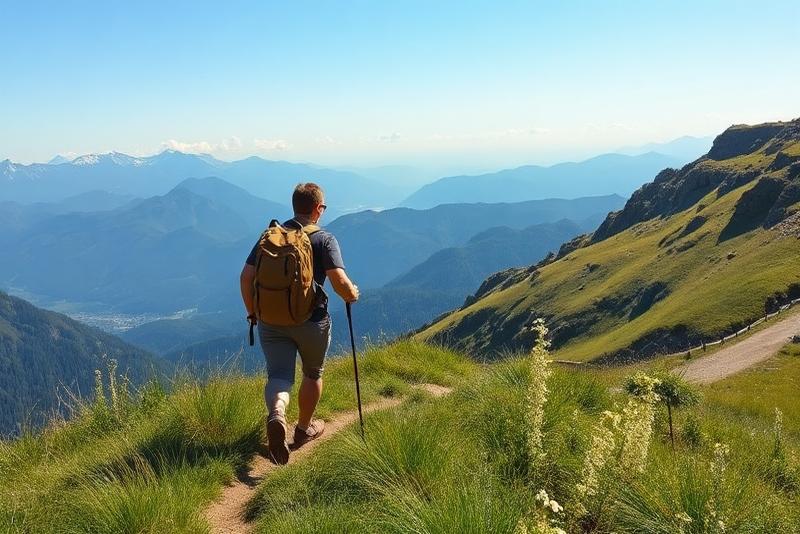
MET-Based Calculation for 90 kg Walkers
The MET formula scales linearly with body weight: Calories/min = (MET × weight × 3.5) / 200. At 90 kg with brisk walking (MET 3.5): (3.5 × 90 × 3.5) / 200 = 5.51 kcal/min.
Walking at 100 steps per minute, gross calorie burn is about 0.055 kcal/step. After subtracting resting metabolic rate (~1.31 kcal/min at 90 kg), the net burn per step is approximately 0.0394 kcal.
500 ÷ 0.053 ≈ 9,500 steps. At a stride length of 0.78 m, that's about 7.4 km and roughly 90 minutes of walking at brisk pace. Compared to a 70 kg person who needs ~12,200 steps for the same burn, the 90 kg walker saves about 2,700 steps — over 20 minutes of walking time.
The Heavier-Body Calorie Advantage
At 90 kg, every step you take moves 29% more mass than a 70 kg walker. This directly translates to higher energy expenditure — about 39.4 calories per 1,000 steps versus 30.6 at 70 kg. You reach calorie goals faster, which can be highly motivating during a weight loss journey.
Pacing Strategy for 90 kg Walkers
Start at a comfortable 4.5 km/h for the first 10 minutes to warm up joints and muscles. Gradually increase to 5.5–6 km/h for the main portion of your walk. Consider interval segments: 3 minutes at power-walk pace followed by 2 minutes at moderate pace. This HIIT-style approach can increase total calorie burn by 10–15% compared to steady-state walking.
Managing Joint Load at 90 kg
Walking generates 2–3× your body weight in knee force per step. At 90 kg, that's 180–270 kg per step. Prioritize proper footwear with shock absorption, choose softer surfaces like grass tracks or rubberized paths, and consider walking in water (aqua-walking) for zero-impact sessions. Strengthening your quadriceps and glutes through bodyweight exercises also helps protect your joints.
Splitting the 500-Calorie Goal
You don't need to walk 9,500 steps in one go. Three walks of ~3,170 steps (about 25 minutes each) burn the same 500 calories. This approach is gentler on joints, fits into busy schedules, and actually improves metabolic response — research shows multiple short walking bouts may enhance insulin sensitivity better than single long walks.
Steps to Burn 500 Calories at Different Weights
| Body Weight | Steps Needed | Distance (km) | Time (min) |
|---|---|---|---|
| 60 kg | ~14,300 | ~10.7 | ~136 |
| 70 kg | ~12,200 | ~9.2 | ~116 |
| 80 kg | ~10,700 | ~8.0 | ~102 |
| 90 kg | ~9,500 | ~7.1 | ~90 |
| 100 kg | ~8,600 | ~6.5 | ~82 |
| 110 kg | ~10,390 | ~8.1 | ~104 |
| 120 kg | ~9,520 | ~7.4 | ~95 |
Flat terrain, brisk pace (MET 3.5), stride length 0.78 m. Heavier walkers may have slightly shorter strides.
Key takeaway
At 90 kg, you need about 9,500 steps to burn 500 calories — roughly 7.4 km of brisk walking. Your higher body weight works in your favor, burning nearly 40 calories per 1,000 steps. Split walks into 2–3 sessions for joint health, and use incline to dramatically reduce step requirements.
Want your exact number?
Real-Life Scenarios
The Three-Part Day
Ahmed, 90 kg, walks to the train station (2,800 steps, 20 min), takes a brisk lunchtime walk (4,500 steps, 35 min), and walks his dog after dinner (5,400 steps, 42 min). Total: 9,500 steps, 500 calories burned, zero gym time required.
The Incline Shortcut
When Ahmed uses a treadmill at 5.5 km/h with 6% incline (MET ~5.5), he reaches 500 calories in only ~10,200 steps — about 71 minutes. He does this twice per week for time-efficient calorie burning while watching sports on the gym TV.
The Social Saturday Walk
Ahmed joins a walking group for a 10 km route through local parks with gentle hills. At 90 kg on mixed terrain (MET ~4.5), he burns 500 calories in approximately 10,400 steps — about 1 hour 44 minutes. The social aspect makes the time fly and increases adherence.

In summary: At 90 kg, you need about 9,500 steps to burn 500 calories — roughly 7.4 km of brisk walking. Your higher body weight works in your favor, burning nearly 40 calories per 1,000 steps. Split walks into 2–3 sessions for joint health, and use incline to dramatically reduce step requirements.