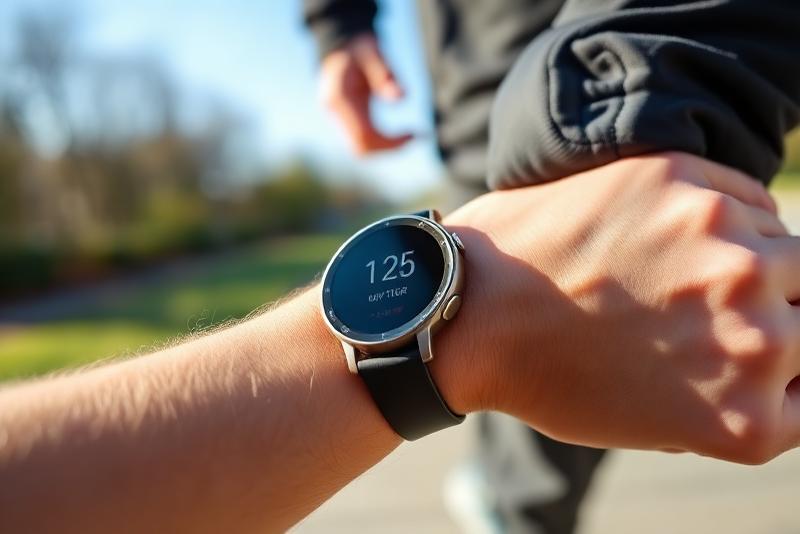
How 1,000 Steps Becomes 0.74 KM
To convert 1,000 steps to kilometers, multiply by the average stride length (0.74 m for adults) and divide by 1,000: 1,000 × 0.74 = 740 m = 0.74 km. In miles that's about 0.46 miles.
Stride varies with height. A 160 cm (5'3") walker averages ~0.66 m/step, putting 1,000 steps at about 0.66 km. A 190 cm (6'3") walker averages ~0.79 m/step, covering about 0.79 km — a difference of 0.13 km driven purely by leg length.
At 5 km/h, 0.74 km takes 9 min. Brisk 6.5 km/h cuts that to 7 min. Slow strolling (4 km/h) stretches it to 11 min.
How long does 1,000 steps take?
At moderate pace, 1,000 steps (0.74 km) takes about 9 min. Brisk pace: 7 min. Slow stroll (4 km/h): 11 min. If you split it across the day — 4 min in the morning and the same after dinner — you hit the total without a single long block.
Calories burned in 1,000 steps
For a 70 kg (154 lb) adult at moderate pace, 1,000 steps burns roughly 38 kcal — about 293 g of body fat energy-equivalent. The range across common adult weights (55–100 kg) is 30–54 kcal at the same pace. Brisk walking bumps a 70 kg walker's burn to about 42 kcal.
How stride length changes the result
The 0.74 km figure assumes a 0.74 m stride. Real strides commonly range 0.62–0.84 m, giving a real-world span of 0.62–0.84 km for 1,000 steps. Enter your exact height in the calculator to remove the guesswork — smartwatches use the same height-based formula internally.
Is 1,000 steps a lot?
Great for breaking up long sitting sessions. Adding a 3–5% incline (mild hill or treadmill) boosts burn by roughly 30–50%.
Calories Burned in 1,000 Steps by Body Weight
| Weight | Moderate Pace | Brisk Pace | Approx. Time |
|---|---|---|---|
| 55 kg (121 lbs) | 30 kcal | 33 kcal | 9 min |
| 65 kg (143 lbs) | 35 kcal | 39 kcal | 9 min |
| 70 kg (154 lbs) | 38 kcal | 42 kcal | 9 min |
| 80 kg (176 lbs) | 44 kcal | 48 kcal | 9 min |
| 90 kg (198 lbs) | 49 kcal | 54 kcal | 9 min |
| 100 kg (220 lbs) | 54 kcal | 60 kcal | 9 min |
Based on stride 0.74 m, distance 0.74 km (0.46 miles), MET 3.5 (moderate) / 5.0 (brisk).
How pace changes your 1,000-step walk
Leisurely
11 min
at 4 km/h
Moderate
9 min
at 5 km/h
Brisk
7 min
at 6.5 km/h
Calorie estimates use a 70 kg (154 lb) reference. Enter your own weight above for exact numbers.
1,000 steps vs the classic 10,000-step goal
That's 10% of a full 10,000-step day — do this 10× to hit the daily target.
10%
of 10k
Weekly
7,000
steps if daily
Monthly
30,000
steps if daily
Yearly km
270
if daily
Calorie burn scales with body weight
Bar length shows relative energy expenditure. A heavier body must move more mass per step, so the same step count burns proportionally more calories.
Key takeaway
1,000 steps ≈ 0.74 km (0.46 miles), takes about 9 min at moderate pace, and burns roughly 38 kcal for a 70 kg adult. Use the calculator to fine-tune for your own height, weight and pace.
Want your exact number?
Real-Life Scenarios
🟢 Commuter — 1,000 steps woven into the day
Maya (65 kg) parks 4 min from the office and walks both ways. Combined with stair climbing and errands, she logs 1,000 steps by mid-afternoon — 0.74 km covered without setting foot in a gym. Her burn: about 35 kcal.
🟡 Weekend outing — 1,000 steps on varied terrain
Daniel (80 kg) walks a mixed-terrain loop for 1,000 steps. Uneven ground and small climbs push his flat-ground burn of 44 kcal up to about 54 kcal. Distance stays at 0.74 km / 0.46 miles.
🔴 Weight-loss context — 1,000 in a 500 kcal daily goal
Anna (70 kg) targets 500 kcal/day from walking. 1,000 steps delivers 38 kcal — 8% of that daily goal. Repeated 5 days a week that's 190 kcal, or roughly 0.02 kg of fat-loss equivalent per week from walking alone.
In summary: 1,000 steps ≈ 0.74 km (0.46 miles), takes about 9 min at moderate pace, and burns roughly 38 kcal for a 70 kg adult. Use the calculator to fine-tune for your own height, weight and pace.