The useful definition is about effort
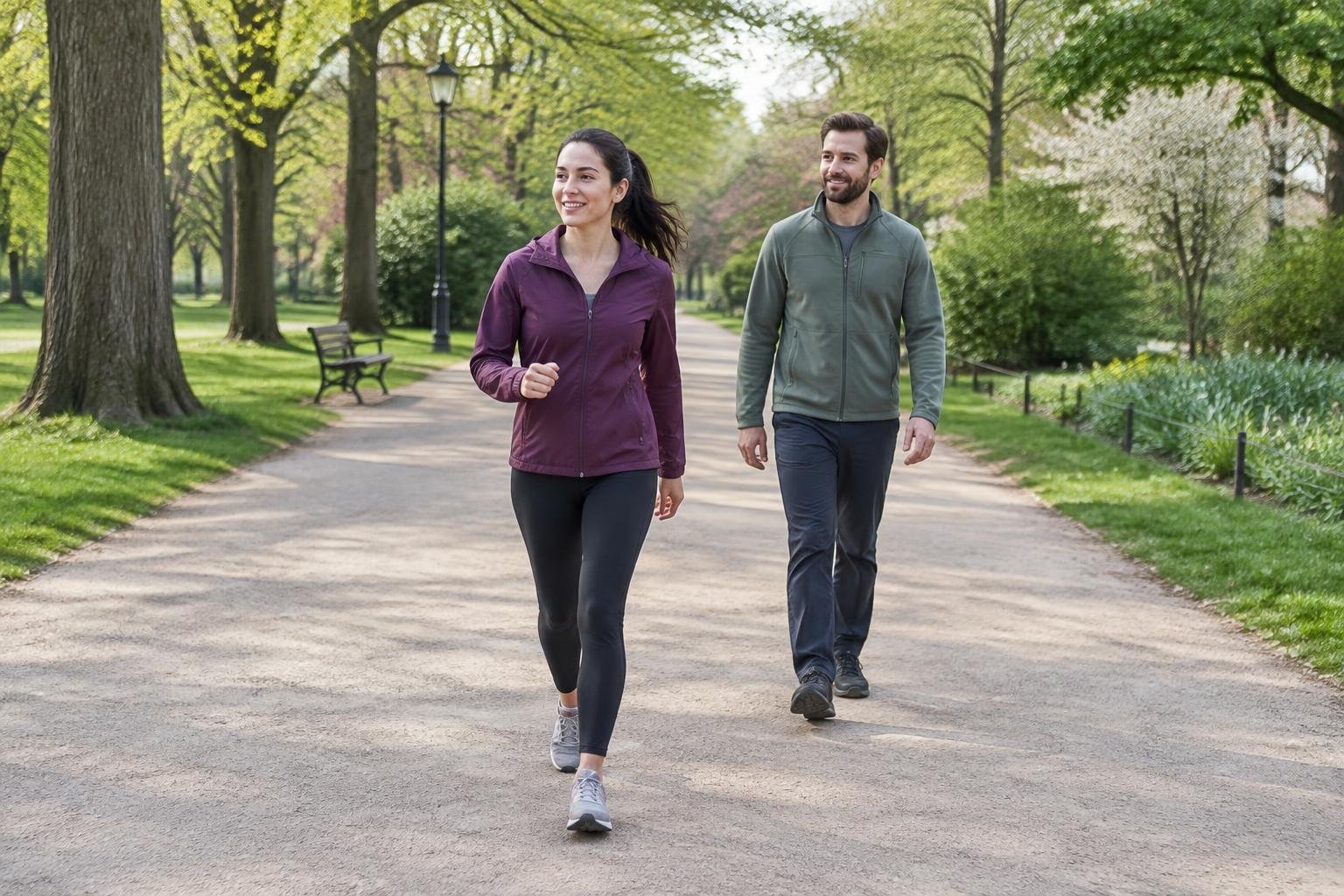
Brisk walking usually means purposeful walking at an effort that raises breathing while remaining manageable. For moderate-intensity activity, CDC's practical talk-test cue is that you can talk but not sing. This is more useful for an ordinary walk than assuming one fixed speed is brisk for everybody.
The word is not a precise individual physiological measurement. A pace that feels easy to one person can be demanding to another. Fitness, terrain, symptoms and walking ability change the effort. This guide is about recognizing that effort—not selecting a universal calorie rate or deciding whether speed matters more than total steps.
Three ways to describe a walk
| Cue | What you observe | What it cannot tell you alone |
|---|---|---|
| Talk test | Whether conversation and singing are comfortable while walking | An exact oxygen-consumption value |
| Speed | Distance divided by moving time | How hard the same pace feels to another person |
| Cadence | Both feet's steps per minute | Distance without step length, or a universal intensity threshold |
If you can speak comfortably but singing becomes difficult, that is consistent with CDC's moderate-effort cue. If you can only say a few words before pausing for breath, the activity may be vigorous rather than the moderate walk you intended. If you have unusual symptoms, do not use a talk test to decide whether to push through them.
What speed counts as brisk?
CDC's measuring-intensity page lists brisk walking at 2.5 mph (4.02 km/h) or faster as a moderate-intensity activity example. That public-health example is not a requirement for every person. It does not mean everyone above that speed is at the same effort or that slower walking has no value.
The following are unit conversions, not intensity zones:
| Speed, mph (km/h) | Time per mile | Time per kilometer |
|---|---|---|
| 2.5 mph (4.02 km/h) | 24:00 | 14:55 |
| 3.0 mph (4.83 km/h) | 20:00 | 12:26 |
| 3.5 mph (5.63 km/h) | 17:09 | 10:39 |
You can measure a familiar route and its moving time to describe your own pace. Keep stops separate: time spent at crossings is part of an outing but not the same as steady walking time. The steps-in-30-minutes guide explains that distinction.
Is 100 steps per minute a reliable test?
It is a useful heuristic, not a pass/fail rule. A systematic review of cadence and intensity discusses 100 steps/min as a practical cue for moderate-intensity walking, while noting individual variation.
In an overground study of 75 adults aged 21–40, a threshold of at least 100 steps/min classified at least 3 METs with 73.3% overall accuracy. That is not perfect agreement, and a young-adult study does not establish a threshold for every older adult or person with mobility limitations.
If you want to record cadence, count both feet's steps for one minute on a safe stretch. Repeat at your ordinary pace. Do not count while crossing traffic or negotiating obstacles. Compare cadence with how the walk feels instead of chasing a metronome number.
Why hills change the answer
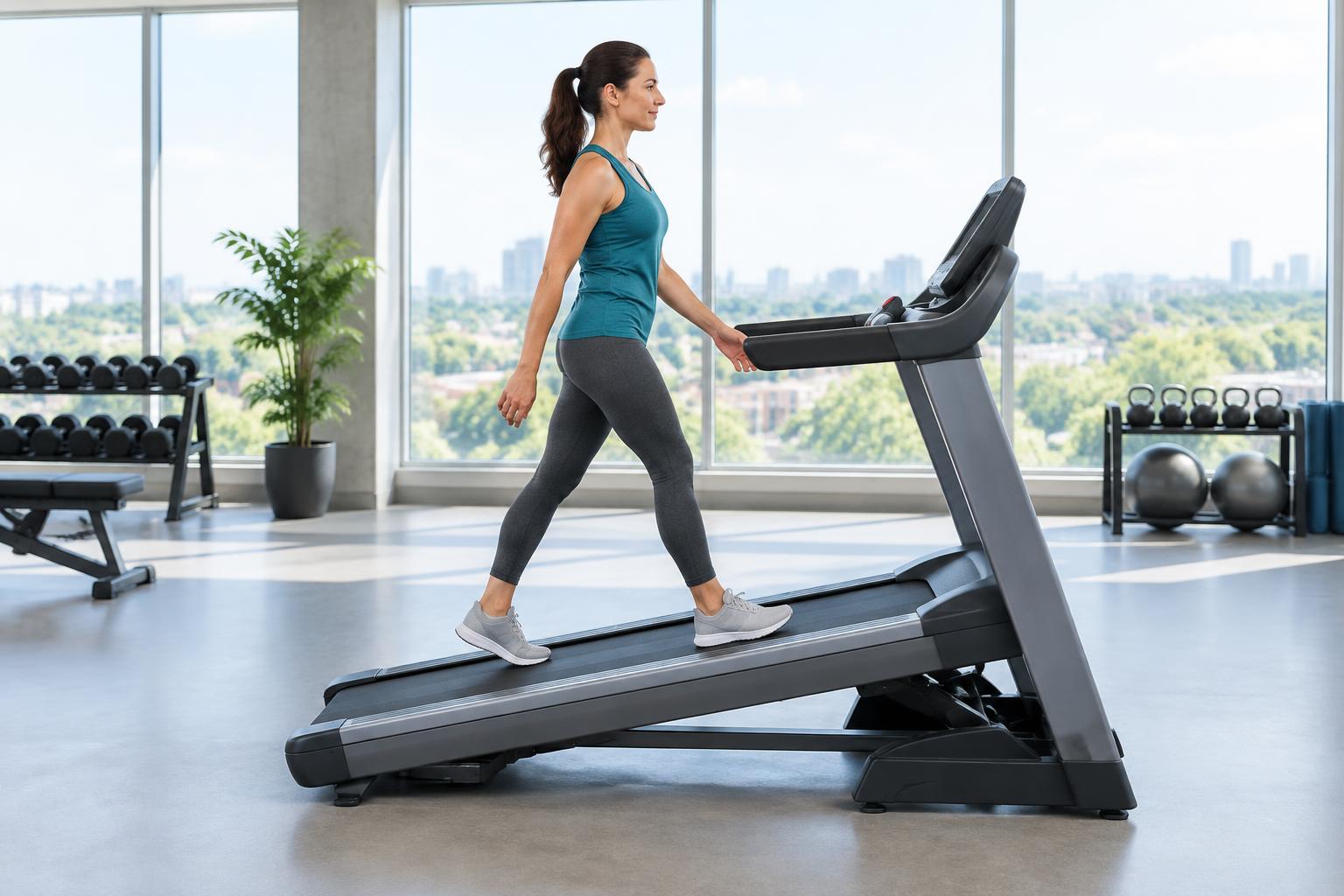
A hill adds demand without requiring a faster pace. A treadmill session at 3 mph (4.83 km/h) and a steep grade can feel very different from the same speed on a level path. Conversely, someone with limited walking tolerance may reach moderate effort at a slower pace.
The 12-3-30 guide explains a named steep-incline routine; it is not a standard brisk-walking prescription. Walking calorie comparison keeps published level-pace categories separate from its incline equation. Do not interpolate an individual MET value from cadence or the talk test.
A practical self-check on an ordinary walk
Choose a familiar route with an even surface and a pace you can control. Notice whether you can talk comfortably and how your breathing changes. You may increase or decrease the pace a little if that is appropriate for your ability, then check again. There is no need to keep the same pace when the terrain or your comfort changes.
Record moving time and, if useful, measured distance or steps. Those observations describe the session; they are not a diagnosis or proof of a future health benefit. If you are returning after illness or have significant symptoms, seek individual advice rather than relying on an internet pace table.
Slower walking still counts as movement. For older adults, balance, strength and function also matter; the after-60 guide explains why a tracker total is incomplete.
Where a walk fits in broader activity
CDC's adult guidance recommends at least 150 minutes of moderate-intensity aerobic activity weekly, or 75 minutes vigorous, or an equivalent combination, plus muscle-strengthening activity on two days. WHO guidance gives a range of 150–300 moderate minutes for adults.
These are general guidelines, not a demand to begin with that full amount or to complete every minute at one walking speed. Activity can be spread through the week, and a manageable starting point depends on the person. Walking does not automatically replace strengthening or, for older adults, balance-focused activity.
Keep effort, calories and health research separate
A more demanding walk can use energy at a different rate, but comparisons also depend on time, distance and body weight. Use the main calculator for personal step/distance estimates, or calorie comparison to examine matched model scenarios. Calculator categories are model assumptions, not a test of whether you personally walked briskly.
The speed-versus-step-count article examines a different question: whether cadence adds information about health outcomes beyond total activity. Observational research cannot turn your talk-test result into a percentage reduction in disease risk.
Common questions
Must brisk walking be 3 mph?
No. A speed can describe a walk, but relative effort varies. Use practical effort cues as well.
Is brisk walking the same as running?
No. Walking is a different gait. You do not need to start running to make a walk purposeful or moderately demanding.
What if I cannot reach 100 steps per minute?
That threshold is not a compulsory minimum. Your ability and effort matter, and slower walking is not worthless.
Can a watch decide this exactly?
Device categories depend on their methods. Do not assume its brisk-minute label matches a research threshold or your individual effort.
Sources
- CDC: measuring physical activity intensity.
- CDC: what counts as physical activity.
- CDC: adult activity recommendations.
- WHO: physical activity recommendations.
- Cadence systematic review.
- Overground cadence validation in younger adults.
Bottom line: describe your pace, but judge a manageable brisk walk with effort as well. One speed or cadence cannot define the experience for everyone.